

Article 5 — Centralized QoE Intelligence: Crowdsourcing Experience at Scale
- Gareth Price-Jones
- Feb 23
- 2 min read

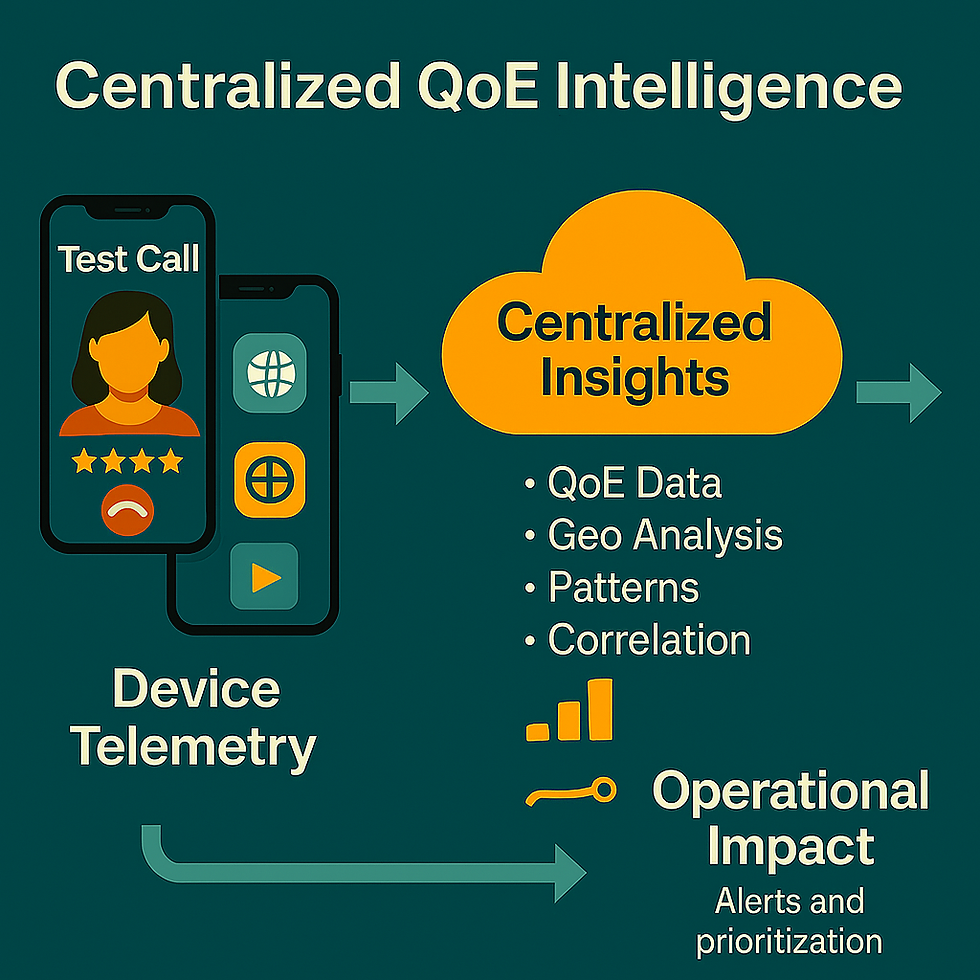
Mobile networks are vast, dynamic, and unpredictable. No single device can tell the whole story — but millions of devices can. That’s the power of centralized QoE intelligence.
QoE AI Insights aggregates anonymized telemetry and test-call data from a massive population of handsets, creating a real-time, geo-aware map of user experience. This isn’t just analytics — it’s a living, breathing model of how the network feels to its users.
In this article, we explore how crowd-sourced telemetry becomes centralized intelligence, and how that intelligence transforms operations, planning, and customer experience.
From Individual Devices to Network-Wide Insight
Every device contributes a fragment of the QoE picture:
• Signal quality at a specific location
• Jitter and packet loss during a session
• Wi-Fi instability in a home or office
• Mobility transitions across cells
• App responsiveness under real conditions
QoE AI Insights aggregates these fragments into a coherent, multi-dimensional view of experience across the entire network footprint.
This enables:
• Real-time detection of regional QoE degradation
• Identification of experience blackspots invisible to RAN counters
• Benchmarking across geographies, device types, and access technologies
• Trend analysis for proactive planning
How Centralized Intelligence Works
QoE AI Insights performs:
• Anonymization — stripping personal identifiers
• Normalization — aligning data across OS versions, device types, and vendors
• Geo-binning — mapping experience to precise locations using H3 or similar spatial indexing
• Pattern extraction — identifying recurring QoE issues across time and space
• Correlation — linking device experience to network-side metrics, alerts, and service events
This creates a live, queryable QoE map — not just a dashboard, but a decision-making engine.
What Operators Can See
Operators gain visibility into:
• QoE distribution by region, access type, and device
• Temporal patterns of degradation (e.g. peak-hour instability)
• Correlation with network events (e.g. cell congestion, transport jitter)
• Impact of configuration changes on user experience
• Comparative performance across markets or vendors
This enables experience-aware operations, not just KPI-driven troubleshooting.
Use Cases Across the Organization
Network Engineering
• Identify underperforming sectors based on real user experience
• Prioritize upgrades where QoE impact is highest
• Validate impact of parameter tuning
Customer Support
• Triage issues based on actual device conditions
• Provide context-aware diagnostics
• Reduce escalations and resolution time
Product and Strategy
• Benchmark QoE across markets
• Inform pricing and positioning
• Support experience-centric SLAs
Enterprise Services
• Validate hybrid work readiness
• Monitor collaboration performance
• Support remote workforce assurance
Why This Matters
Centralized QoE intelligence turns raw telemetry into strategic insight. It enables:
• Faster detection
• Smarter prioritization
• Better planning
• More confident decision-making
It’s the foundation for experience-centric operations — and the launchpad for automation.
Coming Next: Article 6 — Integrating Network Metrics, Alerts, and Service Data
Next, we’ll explore how QoE AI Insights correlates device experience with network-side metrics, alerts, and service data to build a truly holistic view of performance.


Comments